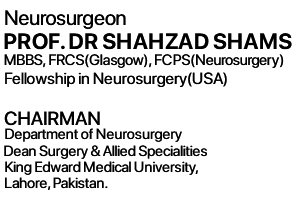


Prof. Shahzad Shams Presently Works as Head and Professor of the Neurosurgery Department at Lahore General Hospital, LGH, Lahore.
Endoscopic Minimally Invasive Keyhole Surgery in Neurosurgery
It is the Best and Latest Technique performed by Prof. Shahzad Shams for the following lesions:
- Pituitary adenoma tumor
- Third ventricle tumors
- Third ventriculostomy for hydrocephalus
- Spine slipped disc surgery
- Intraventricular brain tumors
- Colloid cyst
- Arachnoid cyst
- Pediatric neurosurgery for children
- Cerebrospinal fluid fistula – CSF leak leading to rhinorrhea
I have now a clear belief that the advent of Endoscopic neurosurgery and its advancement has greatly simplified the management of many intracranial ailments in Adults and Children.
Intracranial neuroendoscopy Reduces
- Surgical morbidity
- Shortens the hospital stay of only 24 hours
- Minimizes the cosmetic concerns associated with many major neurosurgical conditions.
In General, Neuro Endoscopy Does Not Require
- Large incisions on the scalp,
- Removal of skull flaps
- Extensive dissection through brain tissue.
In the past several years the technological advancements in endoscope design have been substantial. A reduced size, improved resolution, and brighter illumination of the endoscope have allowed the benefits of endoscopic surgery to be applied in neurosurgery and it is definitely how the future neurosurgery would be performed. Neuroendoscopy has dramatically altered the management of several diseases affecting the central nervous system of children and adults.
At the center of Minimal Access Neurosurgery at Omar Hospital, Jail road. Endoscopic neurosurgical procedures have been used in the treatment of pituitary tumors, hydrocephalus, intracranial cysts, intraventricular brain tumors, lumbar discectomy and decompression for lumbar spinal stenosis and Pediatric neurosurgery in children, Cerebrospinal Fluid Fistula CSF Fistula leading to Rhinorrhea.
Results
The results of Endoscopic Minimally invasive Keyhole surgery in Neurosurgery are one of the best and excellent. Prof. Shahzad Shams is the best neurosurgeon for Endoscopic minimally invasive keyhole brain surgery and Endoscopic minimally invasive keyhole spine surgery Endoscopy.
Prof. Shahzad Shams receives patients from within the country from cities in Pakistan like Lahore, Sialkot, Faisalabad, Bahawalpur, Gujranwala, Gujrat, Multan, Karachi, Hyderabad, Quetta, Peshawar, Rawalpindi and Islamabad, Abbottabad, Rahim Yar Khan, and Sargodha and abroad like from US United States of America USA, United Kingdom UK Britain England, Canada, Italy, Greece, Germany, Spain, Australia, Saudi Arabia, United Arab Emirates UAE, Dubai, Kuwait, India, Qatar, Bahrain, and Afghanistan.


